As mentioned in the preface and with reference to what Luke said about the mission received by Jesus: Thus it is written: “Christ will suffer and will rise from the dead’s world on the third day, and in its name all peoples will be preached, starting from Jerusalem, the conversion and forgiveness of sins”, I begin my story.
1 Adam and Eve around the tree of life
Beyond the symbolism of the tree and the fruit, which are not mentioned here because they are not necessary for the holy author, what lies behind the disobedience of Adam and Eve, it is not simply having tasted another fruit, but the desire to be equal to the creator. The desire to become like God. It will be a constant temptation throughout the history of people of Israel. Jesus, the Messiah, new Adam, will stabilize the true relationship between God and man.

Tree of Knowledge of Good and Evil
Adam and Eve
For a long time, the image of Adam and Eve represented the opposition of two worlds and the different ways of interpreting the creation of the man. Creationism and Evolutionism. The creative act of God and the opposing cosmic chaos from which man would have originated. Opposition between faith and reason, between faith and science. The first story of the more abstract and theological book of Genesis in relation to the following book (which is the most ancient) proposes a classification of all living human beings as they were created in the ascending order of dignity. Indeed, during a symbolic week that concludes with rest, on the sixth day, man enters the scene at the summit of creation, but it is still an imperfect being, since it was created on the sixth day. In Biblical Numerology, the number 6 is actually the figure of the incompleteness, since 7 is the perfect number. God created man on his image, and on his image God created man and woman. With respect to ancient mythologies, the relationship between the two sexes in Genesis is demystified since it does not depend on a divine male and female model. The definition of man is very precise in Hebrew terms – selem – (image) which refers to the link between the reproduced statue and the original, and – Demuth – (resemblance that indicates distance and excludes total identity). The human person is therefore effigy of the Divine only if understood in his sexual bipolarity, and its proper fertility must be considered parallel to the creative act that, while remaining transcendent, it implements its salvific project.
In the texts of the both stories of creation, there is mostly a religious and theological meaning. We cannot find in them significant elements from the point of view of the human sciences. Research into the origins and development of each natural species do not find in this description any rule or positive contributions of essential interest. Indeed, the truth about creation as presented in the book of the Genesis, is not, in general line, opposed to the evolutionary theory that excludes the divine causality. The author (inspired by God) writes with the categories of his time, with the knowledge of cosmogonies of his time (set of myths concerning the origin of the universe), in which he includes with absolute originality the truth about creation of all things, works of an unique God. That’s the truth revealed. The stories of creation but also the whole Bible could be interpreted as a “great love story” between God and the man, between the man and God. The topic of creation is not proposed at one time, but throughout the history of Israel.
2 Path of the history of Israel

Children who cuddle with their mothers and play with animals
(symbolic image of paradise peace)
This path of Israel’s history becomes clear to Christ only when it reaches him. The Church Fathers of the early centuries and the faith of the Church have always taught that full understanding of the path of people of Israel is possible only if we consider that in Christ this path ends. All great cultures have always recognized a creator of heaven and earth, with surprising points in common, even between civilizations that will never externally meet. In this, we can undoubtedly see the very deep contact, never totally lost, between humanity and the truth of God.
However, there were times when Israel was so overwhelmed by suffering, or by the hopes of its history, so bound up with the present, that it no longer felt the need or the ability to turn one’s eyes to creation. The era of greatness, during which the theme of creation became the dominant theme, was that of The Exile of Babylon. Israel had lost its land and its temple. For the mentality of that period, this was incomprehensible since it meant that God of Israel had been defeated, and that it had been possible to take away his people, his land and his worshipers from him. For this reason, the deportation (to tell the truth, there were several deportations) from their own country and the elimination of the map represented a terrible temptation for the faith of Israel: our God is now defeated, our faith is vain. From that time, the prophets, Ezekiel, Isaiah, Jeremiah, opened a new page teaching Israel that only now the true face of their God was manifesting, that he was not linked to a piece of land, and that, actually he had never been. Now it was finally understood that it was not a God like the other gods, but on the contrary the God who had all countries and all peoples available. He had the power to do that since himself he had created heaven and earth.
Appendice
Exile, the apparent defeat of Israel, makes it possible to attain the knowledge of God who is the creator of everything and has power over everything. The Exile of Babylon, in general, is located between the VI and V century BC (probably lasting 50-70 years). It is defined as the deportation in Babylon of the Judeans of Jerusalem and the Reign of Judea in the days of Nebuchadnezzar, ruler of Babylon who reigned between the years 604 and 562 BC. This period proves to be very decisive for the history of people of Israel. Indeed, the definitive writings were made on the basis of previous oral and written translations of the first books of the Bible. During this period we describe the so-called “biblical prehistory” of unknown authors but certainly people of the intelligentsia of the time, inspired by God, tell about the Creation and the history of the Patriarchs who lived in the near East of the second millennium. All peoples, all cultures, indeed, tell us the creation. Their rites, their cults prove it. This unity of cultures concerning the deeper questions that torment the man is something very precious. It is surprising how the great traditions of peoples present a deep unity with biblical faith.
These include an original human knowledge that is open to Jesus. The danger of our technical civilizations is due to the fact of having broken bridges with our original knowledge, and to a misunderstood scientific exhibition which prevents us from listening to the directives of creation. There is a common original knowledge that tells us the road and unifies the great cultures. The modern era began to crumble in the turmoil of narcissism, which cuts the bridges with the past and with the future, and only wants the present, until it reaches an exasperated and thirsty mentality that threatens all of us today.
A first symptom of the new mentality is manifested during the Renaissance, for example in Galileo when he asserts that in the moment that nature does not spontaneously answer our questions and does not reveal its secrets, we will subject it to torture and under painful interrogation we will tear from her the answers she does not want to give us of her own free will. The construction of instruments of natural sciences is for Galileo as the preparation of instruments of torture with which the man, as absolute master, gets the answers he wants to get. The new mentality naturally took concrete and effective forms historically only later and in full measure with Karl Marx. He affirms that man should no longer look after his origins simply because it would be an unsolved issue. Indeed, Marx considered the religions as “opium of the peoples”. With this Marx intends to eliminate the rational question that Hegel had raised, by positioning religion and its values in the sphere of rationality, and where in the context of the history of the creation of Book of Genesis, we attributed to created man at the peak of creative activity the duty to subjugate and protect the earth. This is because creation with its intrinsic rationality is the stronger and more sought after message of the creator from whom we cannot detach ourselves. For Marx, what counts is not creation created but what man is able to produce.
As we know well, Marx secures his thought by the greatest representative of the left who was Feuerbach, but also for example Rousseau, Voltaire, D’Holbach, Lessing and of course Hegel co-founder with Marx of historical materialism and dialectic, without forgetting the “Manifesto”. The latter, in fact, said: “It is not God who creates man, but it is the man who creates God projecting in him the human qualities that are lacking to man”. But in reality he possesses these qualities as a human species, producing an “alienation” that Marx will translate as “opium of peoples” later on. Transformation is the fundamental duty of man for this reason, progress is the authentic truth, while matter is the material with which man creates. Marx’s idea is then transformed into the disturbing thought of Ernest Bloch.
According to him the truth is not the one we know, the truth is only in the change. So for Bloch, the “beauty” is not the splendour of the truth of things, but of course the Prelude of the future towards which we are going and that we are building by ourselves. For that it concludes saying that the cathedrals of the future will be the laboratories, that the churches of the new era will be the electric cathedrals. Then we will not need to make the difference between Sunday and working days anymore, we will not need Saturdays anymore, because the man will be in all the creator of oneself. It will represent nature itself as a change. This thought will be translated on a large scale by Lenin and then by Stalin with destructive results unfortunately.
Their human passage left a wave of blood for the Russian people and on several nations linked to them, and pushed by the will to erase the private initiative to form a “communist” utopian society. And this, by thinking to possess the keys of all the proletarian revolutions to reach afterwards the concentration of the fruits of the human work in a single council under the authority of a single leader and party, with the illusion that all this can be exported all around the world to eliminate all human miseries.
Forbidden all the religions that kept men and women slaves to false hopes. And only at this moment the revolution of the proletariat will stop to justify their misdeeds. From my side, having also lived part of the war of forty, I touched closely the throbbing ideology that also prevailed in Italy even if for a brief period. The hand of God put an end to it through the force of truth, with Pope John Paul II. We could continue the stopover by referring to Nietzsche’s “super man” theory, which will be adopted, but also manipulated by Hitler’s intellectuals. With the announcement of the death of God in “Thus Zarathustra Spoke” by Friedrich Wilhelm Nietzsche, the “superman” is the lonely individual capable of surviving in a world that appears ruled by chaos and without any finality. Nihilism represents the deep decadence of this world governed by pseudo religious and moral certainties. The only possibility for man to survive is to rise above all these restrictions and limitations to nature through the struggle for absolute freedom. Nietzsche concentrates in the concept of “will to power” all the action of man to renew himself constantly and never to fix himself on a so-called truth. This is the concept of Nietzsche that connects deeply to that of “the man beyond” which in the literal sense means “above” others. German National Socialism adopted the concept of “super-man” by transforming it into an ideological foundation of the national socialist party of German workers. Such a notion is translated into a racial ideology as one of the ideological foundations of Nazism by establishing that the “Aryan race” was the special and superior race to be preserved.Here too, let us say, we have made the arbitrary theory of a baseless subdivision of the human species which gave rise to the conviction that there were “inferior human beings” to the point of exterminating 6 million of Jews.
From there, the contours of the turmoil of our time are clearly outlined. Before man could transform some elements of nature in a limited way. Nature as such was not an object but prerogative of its action. Today nature is fully in his hands. And today, more than ever, man is unpredictably exposed to the more serious danger for his own existence. The point of departure lies in this attitude which considers creation only as a product of chance and necessity. Creation has no rights and cannot provide any indication. We no longer feel the rhythm of adoration, the rhythm of the love story of God towards man, and that many civilizations far apart from each other have experienced in one way or another. Today, as ever, it is obvious that we perceive the appalling results of such behaviour. We feel a threat that is not a distant future, but that concerns us directly and personally. The demonstration among a thousand others is the battle of the last few days between Kim Jong, military and dictator, and Trump, President of the United States. The latter responds to the threats of his North Korean counterpart, who claims to have a nuclear button on his desk on a tweet “I have also a bigger, bigger, and more powerful than yours”. If the dialogue between two political leaders rises to such a level, you really have to start worrying. Today, in addition, we are witnessing another disturbing phenomenon. A counter-current phenomenon with the idea of the global village (a vision that, among other things, is not the world of wonders because it destroyed the territoriality, the heritage of each community) that tends to close our borders to migrants from all corners of the world, especially countries at war, invading Western countries.
3 Abraham’s family (clan)
  |
We said before that the creation can be consider a big story of love, in this story the original sin can be considered the thing that ruin a little bit this love however it don’t change his final perfection in Christ. Abraham offering hospitality at the three viandantes represent this in a perfect way, and as a gratitude gesture God told him he will have a son. Trust and Faith without any measure two fundamental concepts necessary to better understand and interpret the Bible.
4 Isaac’s sacrifice
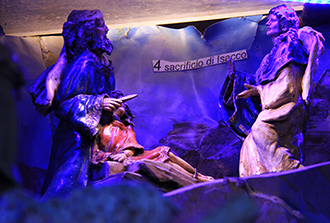

The sacrifice of Isaac appears as if a bloodthirsty (God) gave the order to kill the son of the promise but, if interpreted with depth, can reveal again the true face of the God of Abraham. Above all, this story tells us that the God of Israel does not want “human sacrifices”, contrary to the habits of Israel’s neighbours. This exemplary story forbids the people of Israel to slip into a bloodthirsty vision of faith. In addition, the Bible discusses the “vision of sacrifice” and pain of faith, may still be too diffuse in Christianity. The sacrifice is not positive in oneself. But sometimes the sacrifice becomes necessary to manifest the love, as the beloved, as the mother who watches insomniac on the sick son. This story says among other things that the God of Israel breaks the ancestral link between fathers and sons. Freud would argue a great deal about this, when he himself speaks of the unconscious. The relationship between fathers and sons is heavily undermined by ethical and social paradigms (father, authority, deity, power, law). The Bible dramatically denies all of this. In the father-son bond there is no possession, but freedom, awareness, choice. Isaac belongs to God, not to his father Abraham. In this story Abraham understands that the God of Israel is mysterious. He understands that everything he has given him , he can take it back, that the distance between us and him is immense, and that man must not transform his faith and knowledge into an idol. From this comes the fear of God, which is not fear, but the awareness of the “Misterium Tremendum” (terrifying and fascinating mystery). An expression coined by the historian of religions and theologian Rudolf Otto to describe the “luminous” as something radically and totally different from what is human. Such an expression was later adopted in the theological field. Rudolf Otto held that the intimate essence of each religion was the “Sacred” which manifests itself exactly as “Misterium Tremendum” accentuating the aspect of fear and human trembling in the face of the otherness of the divine. This concept in the field of philosophy also expressed by Heidegger when he talked about the “Ontological Difference”. Kierkegaard defined it rather “an infinite and abyssal quantitative difference”. Abraham experiences absolute obedience. There is a moment when faith is put to the test. Everything seems wrong, our faith becomes naked. In these moments we learn to believe. Abraham saw the otherness of God. In the way of man, we perceive, by approaching God himself, his radical otherness. To love does not mean to own but to belong. For Scripture, fear (of losing love) and love coexist. In this connection, it would be enough to reflect on the current phenomenon of “feminicide” where an extreme desire to possess the beloved is expressed. A “true love” cannot exist if there is no reciprocal “true freedom” . Even the marital bond and even more the parental bond cannot mean owning a person and doing what we want. From this we understand how God, in creating man, lets man betray him exactly by virtue of this freedom.
Ishmael and Isaac (one root) )
Abraham lived, we could say today, in a kind of enlarged family which at the time was recognized by the law, and that the line of descent could also be ensured by the union with a slave belonging to the family nucleus. . Sarah, Abraham’s wife, unable to have children because she was barren and rather old, gave her Egyptian slave Agar to Abraham to unite with her. Agar put Ishmael to the world. From Biblical history we know that the relationship between Sarah and Hagar was not easy. The jealousy was so great that she compelled Agar to flee even before giving birth, and after the appearance of the angel of the Lord, she returned to Abraham promising to submit to Sarah.
5 Hagar and his son Ishmael repudiated.
Abraham got up early in the morning, took the bread and a pot of water and gave them to Hagar, charging them on his shoulders: he delivered her the child and let her go.
|
|

When Abraham’s prayers were answered, the Lord consented to give Sarah a son, Isaac. Sarah demanded and obtained from Abraham that Agar and his son Ishmael were definitely removed. Abraham loved Ishmael and with great despair he backed Sarah’s request. Also in the Muslim tradition, Agar is considered the second wife of Abraham and the mother of his major son Ishmael, and their story is interpreted as a “test” of faith in the Providence of God who will not fail to help the wife and son. Then Ishmael will take an Egyptian wife and become the ancestor of 12 nomadic tribes of the desert. In the Koran he is described as a model of righteousness, as a prophet and as an apostle. For this reason, Ishmael is considered “the noble ancestor” of the Arabs, whose descendants can be defined Ishmaelite. Mohammed the Prophet of Islam, himself, traced his descendants to Ishmael through his first son Nabaioth (major of 12 brothers). The biblical tale of Isaac’s sacrifice and the one from the Koran are the same , but with a fundamental difference that in the Koran we talk about the sacrifice of Ishmael and not of Isaac’s one.
6 Moses (XIII – XII SEC)

Moses (XIII – XII SEC)
Character venerated as much by the Hebrews (considered the greatest prophet) as by the Christians (the one who received the divine law), and later by the Muslims (one of the greatest prophets predecessors of Muhammad). Next to it there is a paranoid pharaoh (maybe Ramses II) who wants to kill all the children of the Hebrews. The new Pharaoh is concerned about the population growth of the people of Israel. Hebrews are people in the people. The Pharaoh said to his subjects: The people of Israel are more numerous and stronger than us. Let’s take steps to prevent him from increasing his power. From that day, their already precarious freedom will live the first restrictions. One of these children miraculously escapes this slaughter and later becomes the liberator of his people. The future hero is saved by the daughter of the one who wanted to kill him. The daughter of Pharaoh disobeys his father, and without knowing, acts according to the plan of God. The people of Israel were living the experience of slavery in Egypt for 400 years now, and in that context they were losing hope of living in their own country and worshiping their own God. Moses, raised in the court of Pharaoh, knows how to be Hebrew and do not forget his people. Indeed, we know that Moses under cover, as we would say nowadays, had as nurse his own biological mother and sister Maria, and it is obvious that they spoke to him of his true origins. He realized the current unbearable condition of slavery of the people of Israel, and following a murder he was forced to flee Egypt, and returned to the lands of Patriarch Abraham, where some tribes still lived, and from where they had not yet emigrated. And this happens in the time of the Patriarch Joseph who had become Vice King of Egypt. Let’s remember the story of Joseph sold by his brothers and the charity that led some tribes to follow him to Egypt. Moses is established in the land of Midian. There he meets Letro’s family and he takes one of his daughters, Zippora, as his wife. He became a shepherd and raised sheep. Someday, something surprising completely changed his life. In the biblical story we know that a burning bush appeared to him (on Mount Horeb). Moses received a mission from the Lord who said to him, “I have observed the misery of my people in Egypt, and I have heard their cry because of their overseers. I know his suffering. I went down to free him from the hand of Egypt and bring him out of this country to a beautiful and spacious land, where milk and honey flow. The cry of the Israelites happened to me. Now, go, I send you to Pharaoh’s house. Bring my people out of Egypt and tell them “I – I am” sent me to you “. What did these words hide to convince the people of Israel so much to follow Moses and flee from Egypt? Certainly at the very moment that Moses uttered these words before the people, it aroused such emotion, thus reviving memories inherited from their fathers: the God of Abraham, Isaac, and Jacob. God will want to take back his people to restore with him a personal relationship, this love story of which we have spoken, to be adored eternally. The painful run away of the People of Israel from Egypt was preceded by the 10 wounds of Egypt, to comply with the will of Pharaoh who opposed their departure. Departure which for the people of Israel meant to renounce this little certainty, in spite of slavery, and to go against a sharp and hard choice, without any certainty. Their God now demands an extreme faith which, through Moses, guides their steps towards the Promised Land, the land of their Fathers. With our words, we will be able to say that the people of Israel are about to make the “big turn”, that is the challenge of their faith. The Israelites, even in their certainties and fears, abandon themselves through Moses, their guide, in the hands of God.
7 Pharaoh with his army pursues the people of Israel.


This represents for the People of Israel the main denouement of all its history in its path towards the fulfilment of the true Easter in Jesus Christ. Before crossing the Red Sea and leaving Egypt, Moses introduces the Easter ritual. The God will pass over to strike Egypt and spare all those dwellings that will have covered the architrave with the blood of the lamb that each family has sacrificed. You will observe this commandment as a rite for you and your sons forever.
From that moment, it is God who acts and leads them through the waters of the Red Sea to the Promised Land. The importance of the passage of the Red Sea evokes Baptism. The purification of people who finally can return to their “love story” with God. Important to understand all the turmoil but at the same time the gratitude of Moses and his people is the Canticle through which Moses and his people express their joy after the flight from Egypt and especially after the miraculous crossing of the Red Sea. “I want to sing in honour of the Lord: because he has excellently triumphed, he has thrown horse and knight into the sea. My strength and song is the Lord, he has saved me …” (Exodus 15, 1 – 18). For the first time, we find ourselves facing a poetic composition. Many Bible books are written in poetic verses such as the Psalms, the Canticle, the Book of Lamentations of Jeremiah, or the Funeral Canticle of David for the death of King Saul (Exodus 15, 1 – 18).
8 Tables of the Law

They are fundamental for Judaism and for Christianity. If we think about it well, the Ten Commandments received by Moses on Mount Sinai are in line with the reflection we have made around creation. Man created and placed in the very centre of the world creates better, expresses better than any other creature this image and likeness of God. For this, God accompanies by the hand the man in the evolution of his history, made also of betrayals, and helps him to recognize himself as a reflection of God and consequently to express his gratitude to God through his thoughts and his actions . The Commandments will have to be interpreted in the light of God’s teaching towards man, whose synthesis will be attained in the person of Jesus who becomes the very fruit of God’s love offered to man.
9 Aronne ( XII sec )

Brother of Moses and first Supreme Priest of the Hebrew People. Aaron’s figure is related to his brother’s story. Having received from God (on Mount Horeb) the order to go speak with the Pharaoh of Egypt to convince him to let his people go, Moses realizes that his stuttering did not allow him and asked his brother Aaron to be his interpreter.Brother of Moses and first Supreme Priest of the Hebrew People. Aaron’s figure is related to his brother’s story. Having received from God (on Mount Horeb) the order to go speak with the Pharaoh of Egypt to convince him to let his people go, Moses realizes that his stuttering did not allow him and asked his brother Aaron to be his interpreter.
10 King David (1040 – 970)

The figure of David is of great importance in the three Abrahamic religions. Judaism, Christianity, and Islam. In Judaism David, of the tribe of Judah, is the King of Israel and from him will descend the Messiah. In Christianity David descends from Joseph father of Jesus. In Islam, David is considered a Prophet. God through the Prophet Daniel revokes his preference for Saul (first king of Israel) because of his refusal to destroy the people of the Amalekites, and in this way the Prophet Daniel secretly anointed David last son of Jesse. The succession was not done immediately; on the contrary David would have calmed the sufferings of Saul with the sound of his harp. He became sympathetic to Saul and his son Jonah. Obviously the most famous episode concerns the duel between David and Goliath, the philistine giant who terrorized the Hebrews. All this gave him the jealousy of Saul, who was stripped of his power which he still exercised, and of such force that he retained in his heart the desire to kill him. David had to flee Saul. Subsequently Saul and his son Jonah were killed in a battle against the Philistines. With the end of Saul’s dynasty, David was proclaimed King of Israel and Judea. David carried the Ark of the Covenant to Jerusalem with the project of rebuilding the Temple. Inside the Ark were kept a golden vessel containing the manna (comestible substance that God brought down from heaven during the pilgrimage in the desert of the People of Israel after fleeing from Egypt), the Aaron’s stick who had bloomed, and the tables of the law. The Temple will be built only later from the hand of his son Solomon. Throughout his reign, the Arch remained in the Tent raised by David. King David, a poet and musician, remained a controversial figure capable of great cruelty, but also of political and human wisdom, and especially to have recognized his own mistakes and limitations..
11 King Solomon and the two mothers (970 – 931)

Successor and son of David. Wise and fair King. During his reign, the Temple of Jerusalem, also called Solomon’s Temple where the Ark of the Covenant was installed, and rebuilt later on. The news of his reign was broadcast throughout the Orient. Large builder of buildings, roads and canals, works that were replicated only during the period of the Roman Empire of Augustus. Among the thousand qualities of King Solomon, we must recall an episode contained in the first book of Kings where his true wisdom emerges in the fact of being able to distinguish good and evil.
Two women claim at the same time the motherhood of a child. After asking who the real mother was, and after the two women claimed motherhood, he ordered the child to be divided in two. Acting in this way he quickly perceived who the real mother was: the one who opposed death could lose his child. As we already know, Solomon’s reign also declined when Solomon, who had many wives, began to worship many deities and the Ark of the Covenant was transported to Ethiopia by his son Menelik.
12 Jonah in the belly of the fish (823 – 782)

The book of Jonah identifies with a unique story. It tells the story of the prophet who evades the mission entrusted by God. A story full of humour. His preaching dates back to the time of Jeroboam II when the King conquered the territories of Transjordan. The Prophet Jonah holds that the reconquest of the lost territories was the will of God thus favouring the warlike initiative of Jeroboam. God ordered Jonah to go and preach in Nineveh, the capital of Assyria at the time. Without going into the details of the studies of historical exegesis, we will examine the personal history of the Prophet. He refuses to go to Nineveh for the city to convert, and decides to flee to Tharsis with a boat that was overthrown during the travel by a storm that endangers the life of the entire crew. He told them of his misadventures and his disobedience to God. For this, to ward off the divine wrath they decide to throw it into the sea, where a big fish engulfs it. In his belly he stayed there for 3 days and 3 nights. After addressing God with intense prayer, the fish vomited Jonah on the beach. Finally, he decided to go to Nineveh and against all expectations (indeed he was afraid of being killed), Nineveh’s people listened to his word and converted to proclaiming themselves to be fasting. God spared the city, but Jonah did not seem to be happy with God’s forgiveness because he wanted punishment for Nineveh. For this reason he asked God to kill him. Nineveh represented an external ideological infiltration for Israel. Nineveh was a clear symbol of oppression for Israel, having destroyed and deported the Kingdom of the North. Jonah refused this new policy. For this reason, he has difficulty in preaching conversion to this city. He does not resign himself to accepting a merciful God preferring a righteous God against the hated Empire like that of Assyria’s one. In fact, Jonas stays 3 days and 3 nights in the belly of the fish. So the Son of Man will stay 3 days and 3 nights in the heart of the earth. The 3 days of Jonah recalls the Resurrection of Jesus. According to the biblical language “3 days” represent the temporal space beyond which death is final and irreversible.
13 Isaiah (VIII century – ?)

The Prophet Isaiah was born around 765 BC. He received his prophetic vocation in the Temple of Jerusalem and ministered for 40 years. Isaiah tried several times to prevent, through his sermon, the annexation of Assyria to Israel and the Kingdom of Judas. He was worried about the moral corruption that prosperity was taking on the land of Judas. The annexation to Assyria comes after a few years with the arrival of the reign of Ezekiel son of Acaz. Even Samaria fell into the hands of the Assyrians (in 722). The political intrigues were such that Isaiah, true to his principles, wanted any military alliance to be rejected, and to dedicate himself to God only. His active participation in the stories of his country makes him a national hero. Considered also poet for the splendour of his style. His idea of God has something triumphant but terrifying at the same time. God is the Holy, the Strong, the Mighty, and the King. Isaiah is the prophet of the faith and in times of crisis crossed by his nation, he asks that we trust only God and hope that a leftover (the rest of Israel) will be spared, of which the Messiah will be King. The Messiah he announced is a descendant of David, who will bring peace and justice to God on earth.
14 Jeremiah (650 – 587)

Jeremiah of the tribe of Benjamin lives in a period of relative peace and prosperity during the reign of Judas and Josiah afterwards. Jeremiah, however, prophesies a hard punishment if the people of Israel, betrayal of the Covenant, will no longer follow the will of God. The threat is represented by the invasion of the northern peoples, especially Babylon. These predictions are interpreted by his fellow citizens as “ominous bird”. For this reason he draws on him hatred and contempt with various attempts to be killed. A lonely man, because of his unpopular message. His message touches uncomfortable themes of the life of the Nation, also sharply criticizing the lives of the governants who demoralize the country. Nobody listens to him, even when he announces the eminent invasion of the Babylonians. Even then Judeans prefer to listen to false prophets who promise a future of peace and prosperity. A curious detail: during the takeover, some notables decide to throw Jeremy in an old well full of mud to prevent the misadventures announced by him to demoralize the soldiers. The reign of Judas thus ends with the Exile of most Judeans in Babylon by the conquering King Nebuchadnezzar II in 597.
15 The Annunciation

The prophecy of Isaiah that announce the arrival of the descendent of David happened. The Archangel Gabriel, sent by God, appear at Mary who came from Nazareth and who was the future wife of a man belonging to David’ s dynasty. He said her that she would give birth to the son of the Almighty. From here it starts a new period for the Christian religion and from this moment you can easily find much more differences from the others monotheistic religions.
16 The visit of Mary at St Elizabeth

Mary full of joy started her voyage in order to reach the city of Judea and visit her cousin Elizabeth. Our holy Mary started to show us the love for others.
17 Birth of Jesus.


The event of Jesus’ birth is inserted in this story woven by God with his people, exactly this love story between God and the man of whom we spoke.
So Jesus does not come like a meteorite, but as a fruit of this way, to the point that the idea of a living temple, not that of stones (in opposition to the rebuilt Jerusalem Temple several times), will accompany the sermon of Jesus and the apostles.
Jesus Christ will represent the cornerstone of the new Temple, and the Temple will be his very body. With the birth of Jesus, we can say that a new Creation will replicate itself. Christ comes among us , the presence of God fills the cosmos, the history and the heart of man.
18 The Wise Kings in front of Herod.

From the first centuries of the Church, the Wise Kings were associated with positive behaviours of seeking spiritual light and denying darkness. Among the three gifts they brought with them, myrrh is the most important (medicinal plant which is extracted a gummy resin which, mixed with oil), was used to make ointments with medicinal, cosmetic, and also religious purpose. Christ, indeed, means “unction.” Symbolically with this gift given to Jesus by the Wise Kings, his divinity asserts itself.
19 The Wise Men return but through another ruote.

The history tell us that the Wise Men had to take another route to return home. Jesus had to be saved in order that his message reach us today.
20 Massacre of Innocents.

The massacre of the children wanted by Herod seems to be like that one suffered by the people of Israel throughout its history. As then, the fear that the people of Israel may become more powerful, the Pharaoh orders the murder of all the children of the Hebrews. Thus Herod, afraid to be dispossessed of his power, orders the assassination of the innocents. God, however, continues to write his story, though the vetoes that the power man sows in his path.
21 Jesus’ Baptism

Thus, as the Mother devotes herself to the others, Jesus before starting to announce the good news receive the seal of the Holy Spirit. He did it as a man although the uncertainty of John the Baptist in order to begin to follow the Father’s will. The Love that God had demonstrated for the Israel’s community now is shown evidently with His son Jesus Christ, thanks to what now we enter in a new creative dimension where God is father.
22 Marriage of Cana.

This is the beginning of the signs accomplished by Jesus. We want to emphasize the presence of Mary his Mother. Her presence will always be discreet, never protagonist, who will accompany his son under the cross and the final hug of the deposition.
23 Healing the paralyzed.

Jesus, being in Jerusalem for a Hebrew holiday, goes to the pool of Bethesda near the sheep gate where usually there were a large number of cripples, blind, and paralyzed.
24 Healing of the born blind

The popular contradictions well described in John’s Gospel are now downplayed and concealed.
Passing by, he came across to a born-blind man, and his disciples question him: “Rabbi, who sinned, this man or his parents for his blindness?”. ‘Neither this man nor his parents sinned,’ said Jesus, ‘but this happened so that the works of God might be displayed on him.” The doctors of the Bible said that He did not observe the Saturday festivity.
“This man does not come from God as he does not observes the Saturday festivity… in contrast with Jesus’s teaching that aimed to love and care for others rather than the observance of old laws.
25 Vocation of Matthew.

Jesus sees a man sitting at the tax office, called Matthew, and says to him, “Follow me.” And this one got up and followed him. Jesus looks right to the heart and not to social or religious affiliations.
26 Speech of the Beatitudes.

It is above all the fulfilment of the Ten Commandments. This speech recalls the main values of Christianity. St. Augustine will say that his speech of the mountain expresses in full all the norms that regulate the Christian life. The revolutionary path on the beatitudes discourse indicates to us the paradoxical happiness of the lasts becoming the firsts thanks to God’s action.
“Blessed are the poor in spirit: for theirs is the kingdom of heaven” (Mt,5).
Blessed are those persecuted by the justice: for theirs is the kingdom of heaven. (Mt, 5, 10).
How do we face the lasts, the marginalized, the refused and the different? We can advocate that the discourse of the mountain (more symbolic than physical) reflects another mountain in the biblical history: the Mount Sinai. From its summit the Word of God came down, the Torah, the law for excellence of Israel peoples, from the parallel summit, which dominated the lake of Tiberias, came down Jesus’ Word and his interpretation of the Torah. The “blessed” is then the one who is able to look above, up to the eternal and he listens to the message. The discourse is meant for everyone, not only for the disciples that sat next to Jesus. The beatitudes the Jesus announced are revolutionary news, being a model of happiness that opposes itself to to what is spread by the media and by the dominant belief.
27 Multiplication of breads and fishes.

Jesus was compassionate to those who had listened to him and had no food. The earthly bread symbolizes man’s desire to feed on the word of God.
28 The Resurrection of Lazarus.

Lazarus was a friend of Jesus. The Resurrection of Lazarus is the last miracle that precedes the Passion and Resurrection of Jesus.Lazarus was a friend of Jesus. The Resurrection of Lazarus is the last miracle that precedes the Passion and Resurrection of Jesus.
29 Jesus gives Peter the keys of the kingdom.

Jesus leaves to Peter and his disciples, not a territorial power, but the strength of the Holy Spirit through which they can be instruments of the new evangelization.

Against the opinion of the disciples, Jesus decides to go to Jerusalem for Easter. Here comes the radical fulfilment of Hebrew Easter. The sacrificed Lamb is Jesus who offers himself first during the Lord’s Supper and then on the Cross.

The betrayal of Adam and Eve a more significant “echo” in Judas’ betrayal. God leaves man free to the betrayal of his Son.

All political and religious authorities are coalescing to condemn Jesus. In reality their choices contributed to the fulfilment of this love story that God had interpreted from the moment of creation.
33 Peter accused by some women.

Even Peter, who, though the fact that he had received the trust of Jesus as a new leader of the Church that would have come true after the death and resurrection of Jesus, does not have the immunity of betrayal of Jesus. However, Peter, unlike Judas, believed deeply in the strength of the Love of God announced by Jesus his Master. In the story of Peter, it is love that will triumph over the sinner.
34 Peter and the Rooster’s Song while Jesus brings the Cross.

It is said in Zohar, a book of the kabbalah, that when a Rooster sings three times this is a omen of death. The story of Peter and the Rooster’s song is linked to another more ancient tradition that linked it with the death and the resurrection of the Savior.
35 Jesus crucified with the two thieves

This episode seem to show us that Jesus wanted to reveal us, that also in the desperation of the death, it is possible the salvation. The only thing that you have to do it’s believing that He gave us life for our salvation. In this event is evident the contradiction between the two thieves.
35 Jesus entrusts his Mother to John.
Jesus entrusts the Mother to John. Jesus close to agony addresses his thoughts to the mother. He may be worried that she is left alone. “Woman, here is your son”. The disciple John was under the cross. It is to him that Jesus entrusted his mother. Only, we know that Jesus also entrusts John to his Mother.
Certainly the human dimension in these words of Jesus is obvious. But Jesus, in this double delivery between the disciple and his mother, looks at the emerging Church which needs to be protected before receiving the staggering energy of the Resurrection, the presence and the gift of the Holy Spirit afterwards.
Mary represents the death of Jesus, the person who generated him, but especially that the one who preserved more than anybody the “Mystery of the Incarnation and the Passion of his Son”. So, who better to keep alive the memory of Jesus among his disciples, who were already experiencing the illusion of having lost their Master, and they could not do anything to prevent everything from happening? The proof is that Jesus Resurge appears to them at the moment that the disciples, probably with Mary, were gathered together in the Cenacle.
The appearances of Jesus Resurge serve to give the certainty that all the teachings they received from their Master were intimately related to the events of the Passion – death and Resurrection. Jesus to give proof that he is not a ghost, he asks them something to eat. First with the disciples of Emmaus, and then with his disciples.The act of eating reminds them of moments of great intimacy, before the Passion, where Jesus announces symbolically his Sacrifice and the Eucharist that the Mystery would have perpetuated.
36 The Centurion pierces the sides of Jesus with a spear.


When the soldier hurts the odds of Jesus “it came out blood and water”. The real spearhead attests to the real death of Jesus. The Evangelist John (John 19: 23-37) sees a deep meaning: like the rock that wounded Moses, a source of water in the desert brought out, so the sides of Christ disgorged a torrent of water to eliminate the thirst for new of God.
This torrent is the gift of the Holy Spirit. Moreover, as from the odd of Adam asleep was extracted an odd to create Eve, so the odds of Christ, asleep on the cross, in the sleep of death, was extracted the Church, his wife. It was formed from water and blood, that is, Baptism and Eucharist that disgorge from the wounded heart.
These theological concepts are translated by the image of the Merciful Jesus who appeared to Saint Faustina Kowalska, a Polish nun of the Sisters of Mary the Blessed Virgin of Mercy. “You saw the Lord Jesus dressed in a white robe with his hand raised, and two rays of sunlight coming out from his heart, a white ray and a red ray, symbols of the water and blood of Jesus. The figure of Jesus surrounded by a blue light and with a writing. Jesus, I trust you. Saint Faustina was the one who spread the devotion to Merciful Jesus.
Video

After the silence in front of Jesus Crucified between two mobsters and facing the centurion, who confirmed the death of Jesus, do not hesitate to inflict a spear thrust in the sides, Mary mother of Jesus is at the foot of the cross ready for the last embrace of this martyred body that had drawn on him all the hatred of those who could not read in his words the infinite love of God who had become man among men.
38 The Sepulchre.


Joseph of Arimatea, friend and disciple of Jesus, offers “his new sepulchre” dug in the rock to deposit the body of Jesus. After so much suffering, finally a kind gesture of a man who had loved Jesus, who had even listened to his words.
With this ultimate gesture, everything seems to be accomplished. Even his disciples collapse in sadness, like the disciples of Emmaus, that all is over; that this exciting adventure lived alongside their Master has come to an end.
On the contrary, it is in the silence of the sepulchre and the death of Jesus that God gathers all the creative energy, with the expectations and hopes lived by the people of Israel to prepare the moment of the victory of life over the death.

The women who went to the sepulchre on the first day after Saturday are told, “Why are you looking for the one who died? He is not here, he is raised “.

“My Lord and my God.” Jesus said to him, “Because you saw me, you believed me. Happy are those who will believe even if they will not see me.

Jesus walks with the disciples of Emmaus saddened by the death of their master … “Are you the lonely stranger in Jerusalem not to know what has happened during these last days? … Idiots and heartless those who do not believe in the word of the prophets … “
42 Supper with the disciples of Emmaus.

He stays with us because it is late. When he was at table with them, he took bread, said the blessing, broke it, and gave it to them. Then their eyes opened and they recognized him.

“You are Peter and on this stone I will melt my Church”. This was a prediction that he thought too big for him in fact at his death he decide to be crucified backwards to not imitate his Master.
44 St Paulo. “The Apostle of the People” .

He didn’t knew Jesus in life but he knew, as he said, Jesus Christ Rise Again. St Paulo was the main missionary of Jesus’ gospel between Pagans, Greeks and Romans.
We listen and saw all from the creation until the death of Christ and his disciples’ reflections , but what happened to the sowing of the Messiah ?
45 St. Augustin.

One of the greatest Christian thinkers of the first millennium. Not only he was a great theologian and man of culture, but he was also the one who spoke to the heart of man with all his weaknesses and with an impulse of love towards God. We recall between his works “My Confessions”.
Video
46 Medieval era

Since the fall of the Western Roman Empire to the discovery of America. After the fall of the Western Roman Empire starts the period of the High Middle Ages until the XI century. This storic period was remember as a crisis’ period.
Then starts the Low Middle Ages until the XIV century. Where there is a upswing of Europe that culminate and end with the discovery of America. It is also the historic period where we collocate the Crusades.

Dominican friar, theologian and philosopher. It contributed to create some pillars of Theology and of Philosophy for the Christian Church.
He managed to unify the classic Philosophy with the Christian one. He was interested about important issues such as: “Faith and Reason” and the existence of the soul in Religion and in Theology. “The Summa Theologiae” is the work that gather all his beloved issues.
48 Modern History.
Since the Discovery of America until The French Revolution. It is the period where happened the Italian Risorgimento.

Since the French Revolution passing through the Industrial Revolution ( second half of the XVIII century) until our days.
Now I asked myself, if reach our days will be the end of my story accompanied with images. But and the Future?
Who will talk about that after? I bring prompt to answer my doubt to some extracts of the Apocalypse written by John.
This is the last book of the Bible and so of the New Testament and it is the only Apocalypse who there is in the Bible. It belongs to the group of New Testament writings known as “John’s Literature”;as written, if not by the Apostle himself, in circles that referred to him and his teaching.
50 The Woman and the Dragon (in the Apocalypse).

They constitute chapter 12 of the book of the Apocalypse (whose value is symbolic). This is the struggle between good and evil that began with the original sin. Work positioned in a period of turbulent and violent persecution against the nascent Church, around the time of Nero (70 AD). When the author writes: “The Church, new chosen people, was scarcely decimated by a bloody persecution of Imperial Rome which imposed the pagan worship of the Emperors (the Christians were accused of having set Rome on fire). Indeed, Christianity seemed to Imperial Rome to be a sort of “atheism” because it denied any traditional deity.
So, the Apocalypse, in the image of the Woman and the Dragon, emphasizes as “the love story” between God and man started since the beginning of creation is constantly threatened throughout history from the people of Israel to the advent of the Messiah, and even during the first centuries of the Church (and also in our modern age) when Christianity was to assert itself despite persecution. For that, the symbolism of the woman in the vision of the Apocalypse can adopt the image of the “new Eve”, without sinning, who will be mother of the entire human race. The woman fleeing into the desert may be the image of the people of Israel that God will constantly protect against any initiative of destruction. Moreover, the Woman is the image of Mary of Nazareth, Mother of Jesus, and Mother of the nascent Church. The Dragon, therefore, represents Satan as the Evangelist John (author of the book of Revelation) identifies with the “ancient snake”, the same snake that drove Eve to accomplish with Adam the Original Sin.
The seven heads of the Dragon symbolize the evil that is renewed in the history of man because of those who sometimes, unwittingly, act on behalf of Satan. Indeed, in medieval times some commentators were involved to identify certain heads of the Dragon, as for example in Nero and other persecutors … Finally, the child born by the Woman and kidnapped by God, before the Dragon devoured him is Jesus Christ, the one who will conquer definitively over the forces of evil and Satan. The vision of the Apocalypse is therefore very positive, despite the tragedy of the story. He affirms an important fact: God is with his new people, whom he has united with him through his Son, Emmanuel “God – with – us”. Jesus will say in Mt 28, 20 “I am with you forever, to the end of the world.”
51 The dragon with the seven heads.

The big dragon, the ancient snake, the one who we call Devil. He underthought a war in the sky against Michael and all the others god angels. Because he lost he was sent in the earth and here he underthought a war against the Woman and all the Christians. He joined forces with others evil’s powers. The beast. “I saw a beast rise from the sea.” The sea in biblical symbolism indicates a myriad of peoples and peoples. Derived his strength from the dragon, from Satan. It is opposed to Christ as a false Christ. St. Paul also calls it “;adversary”.
His number is the 666 that could indicate a person placed at the top but that makes a negative use of the powers, for example Nero. In other texts, the beast’s number is associated with the number 616, because it was not calculated in the sum of the second letter “N” in “Nero” (in Greek it is written in a different of course).
This person is helped by another being of darkness, called a second beast, false prophet or beast of the earth. The Koran places these people both in the same place, where El-Dajjal reigns. Babylon The great. She is described as a prostitute to consider the commoditimony linked to the religion. Christians have to fight the power of evil having the centanity that, although the evil is powerful and it found always more alliedes, at the end will be defeated.
52 Tail of the Dragon.


In the Apocalypse we read: his tail dragged a third of the stars of the sky and made them rush to the ground. This is the allusion to the fall of the wicked Angels, trained by Satan.


This is the very image of Satan. In its etymology it means “light carrier”. The rebellious Angel chased from Paradise and precipitated into the abyss of the Underworld.
Saint Paul often speaks of Satan disguising himself as an angel of light. Some heretical currents of thought have interpreted Satan as the one who leads man out of the darkness of ignorance (in which God would like to see him), by granting him the gift of free will and truths.
54 The Damned.
Like those angels who fell into the depths of the Underworld, the damned are those who work for Satan and are fascinated by it. They are punished in different forms, depending on the sin committed, but all for eternity
.
Video

A reference to our time, full of fears and of contradictions where the one who have more power than the Be itself and the research of himself, untied from God, bring you to a life without safeteness.
56 Pope Francis with a family and merciful Jesus.

Our current Pastor, protector of the poors and of who go at the research of the true Word.
57 Jesus’ mother

We are in front of the Virgin Mary of Lourdes. In the apparitions it is revealed the Mystery of the Immaculate Conception to the little Bernadette who didn’t know but she only accepted with joy this Divine mystery who was completely unknown to her. The presence of the Holy Mary is constant in the Church’s history.
The Woman of the cavern revealed her vocation to be Jesus’ mother. Her all existence consist in giving birth to Jesus and it is all linked to that. She is Immaculate because she is inhabit by God. it is for this reason that also the Church and every Christian have to let themself live by God to become Immaculate and so Catholics Christians testimony in the history.
What safer means can we be provided except by Her who Jesus entrusted us, in a symbolic way, in reference to John: “Woman this is your son” including, in that son, all of us.
Video

Perhaps it is no coincidence that we are once again referring to the consideration that not everything is always lost. Mary to whom Jesus is entrusted with the life of all of us, try to help us to re-come up, however it was our earthly life. Relying on her and the Angels who have been there assigned to help, we will be able, with our will, to recover the Salvation. She is our help to save us from eternal damnation.
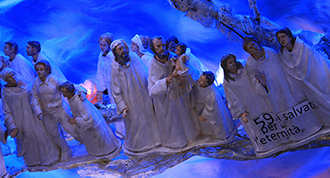
The crowd of the Saved are bring to the doors of the Heaven but what the Apostle see inside it isn’t reported, as it is ordained by the Angel guide.
Traced back to the firmament and arrived at the gates of the sky, located above the Ocean River, Paul lies in a new scenario: from here you can see the two places in souls of the righteous waiting for the Final Judgment are destined, the first is the promised land, in which flows a river of milk and honey, the other is the garden of Eden. Then in other moments you can found it always in an atmosphere of beatitude.

So the King will say at the ones who are at his left: away from me, cursed in the eternal fire, prepared for the Devil and for his Angels because “ I was hungry and you did not feed me; I have had thirsty and you did not give me a drink; I was naked and you didn’t have me dressed, I was a stranger and you did not host me, I was sick and incarcerated and you didn’t visit me, and at my death you didn’t have compassion of me”.
61 At his right.
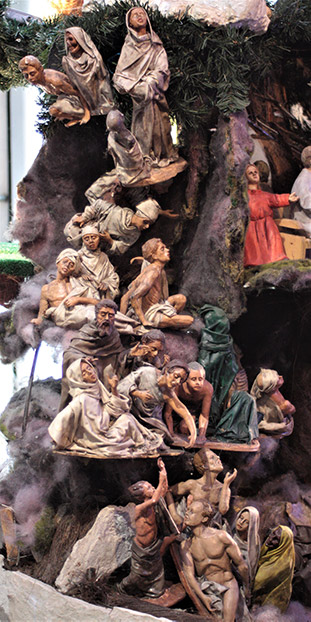
Then the King will say those who are on his right : “come and be blessed by my Father, receive in heritage the Reign prepared for you from the day of world creation. Because I was hungry and you gave me food. I was thirsty and you gave me something to drink. I was a stranger and you welcame me….Every time you gave these things to only one of my youngest brothers, you did it to me”.
62 Trinidad.

It is the perfect synthesis that describes the dynamism and vitality between Father, Son, and Holy Spirit. In the definition of God “One and Trino” we want to emphasize the uniqueness of God but also the distinction of the three figures: Father, Son and Holy Spirit.
To try to understand this mystery, let’s say that “creation” is the work of the Father who wanted the creative act to reach its summit in Christ his son. On this, we must say that the mystery of the Incarnation is not directly related to the Original Sin as if God was compelled to remedy the betrayal of Adam and Eve, but his Son has been part of it since Eternity.
This concept is very well explained in the prologue of St. John when he says: “At first it was the Word, and the Word was at God’s. Everything was done through him, and without him, nothing would have been done of all that exists … “. The love of the Father and his Son generates the Holy Spirit who, in line with the Father and the Son, acts in the Church today and governs the same creative action undertaken by the Father.
So the Trinity can be defined as a spiral of Love that everything attracts and everything generates. If it is possible, we could compare it with a huge “black hole” that draws matter into a whirlwind that generates new galaxies afterwards. Every time you did these things to one of my younger brothers, you did it to me.
63 Creation.

Creation is participation of the very essence of God. To understand these words in depth, we must read again the text of the second story of Gen 2 (or even better complementary to the first) of the creation that belongs to the older tradition.
A story of man creation different from the creation of the world. “Then the Lord God plasmaed the man with the dust of the ground and breathed in his nostrils a breath of life, and the man became a living being …”. We know the rest. The man, having not found a help that was similar to him, God creates a woman with one of its odds. Then creation reached the supreme expression when God said, “Making man in our image and likeness”.
64 The Archangels.

Its etymology means “chief angel”. In the Judeo-Christian tradition, there are 7 archangels, but there is no concordance on their names. Usually, in the canonical books of the Bible, Archangel Michael is mentioned most of the time.
Throughout the centuries, the Church will allow the veneration only of Archangels Michael, Gabriel, and Raphael. It was only in the sixteenth century that their names appeared with devotional interest. The seven Archangels are: Uriel, Raphael, Raguel, Michael, Sariel, Phanuel, and Gabriel.
In the Middle Age, the Catholic Church established that worship and veneration was lawful only for the three Archangels: Michael, Gabriel, and Raphael. Who are the Archangels, and what are they doing? The latter always contemplate the face of God.
These are the spirits who live through him and in him, but also near men. Archangel Michael is the warrior who fights against Satan, the defender of those who love God. The Archangel Gabriel is a spirit very close to God who announced the birth of John the Baptist to Zechariah and that of Jesus to Mary. The Archangel Raphael has the mission to bring healing. Indeed, his name means “medicine of God”, often represented with a vase of medicines.
65 Lucifer, fallen Archangel.

The term fallen angel points to a fallen angel from his state of grace and, for this reason, turned away from Heaven. Often such exile is a form of punishment for disobeying or rebelling against God.
One of the first sources concerning angelgia and demonology is the Persian prophet Zarathustra who would influence some aspects of the Jewish and Christian religions.

Angels are creatures with power and abilities greater than those of human beings. They live in heaven, or spiritual world, which represents a higher level of existence than the physical universe.
That’s why they’re also called spirits. God created angels through Jesus, defined in the Bible as “the first-born of all creation.” Describing the way God employed him in creation, the Bible says, “Through him all the other things were created in heaven and on earth, the things visible and things invisible also angels were created.
The creation of angels goes back as far past, even before the earth existed. When this was created, in fact, the angels “issued cries of applause”.
67 The Roses: Beauty of Creation.

The rose at the end of my story as a symbol of the image of the Virgin Mary. The reference of the flower multiple names and disparate colors, corollary to the image of Mary who always listens to us and supports us on our journey Terrestrial.
Even the time correspondence, the month of May, matches the flower to Mary, mother of Christ and our supporter to father and son .
68 Universal Judgement.

The Universal Judgment or Final Judgment, according to the Christian eschatology, it is an event that will occur at the end of time, immediately after the Second Coming of Christ.
According to theology, in fact, the fulfillment of the stories of freedom experienced by every man “to be aware of the ethical quality of these stories. in front of God.” Furthermore, “in the biblical testimony that Jesus will be the judge is contained the promise that God’s judgment on evil and on every fault will be a judgment of grace.”
Thanks
For me it is a duty to forward a thank you to all those who collaborated so that this project can be achieved, and so that the ideas which were in my mind can take shape to be more easily transmitted.
Special thanks to the two sculptors: Marco Gutilla from Palermo gutilla.marco@libero.it , and Antonio Vertulli from Perugia.
www.antoniovertulli.it